
Why the Industry Needs Model Context Protocol (MCP)

In 2026, AI systems are no longer judged only by how intelligently they answer questions. They are judged by how effectively they connect, understand, and act across business systems.
That is exactly where Model Context Protocol (MCP) enters the conversation.
MCP, introduced as an open standard by Anthropic and documented through Model Context Protocol Documentation, is often described as the “USB-C for AI applications.” Instead of building a custom connector for every database, CRM, API, and file system, MCP creates one standard language between AI models and external tools.

1. The Real Business Problem
Imagine a fast-growing education startup called LearnNova.
The company uses:
Salesforce for student leads
Slack for team communication
Google Drive for training documents
GitHub for engineering workflows
PostgreSQL for student analytics
Now leadership wants an AI assistant that can answer:
“Which premium students haven’t renewed subscriptions, what feedback did they leave, and create a retention plan?”
Sounds simple.
But behind the scenes, the AI needs to:
Pull billing records
Read support tickets
Search meeting notes
Check product usage
Generate an action plan
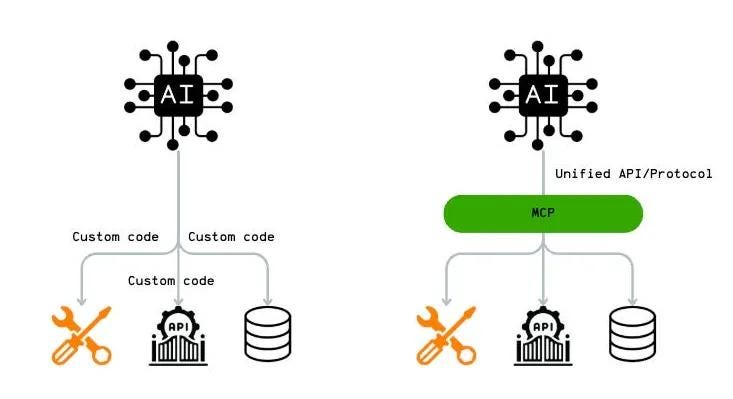
Without MCP, engineers usually build 5 separate integrations—one for each system.
Then another AI model is added.
Then another team.
Suddenly, the organization is maintaining dozens of fragile integrations.
2. The Traditional Architecture Problem
Without MCP:
AI → Salesforce API
AI → Slack API
AI → Drive API
AI → Database API
AI → GitHub API
Every connection needs:
Separate authentication
Separate data formatting
Separate retry logic
Separate permission rules
This creates:
A. Engineering Complexity
Every tool needs custom code.
B. Security Risk
Multiple tokens and permissions across systems.
C. Scaling Failure
Adding one new system means rebuilding integrations.
3. How MCP Solves It
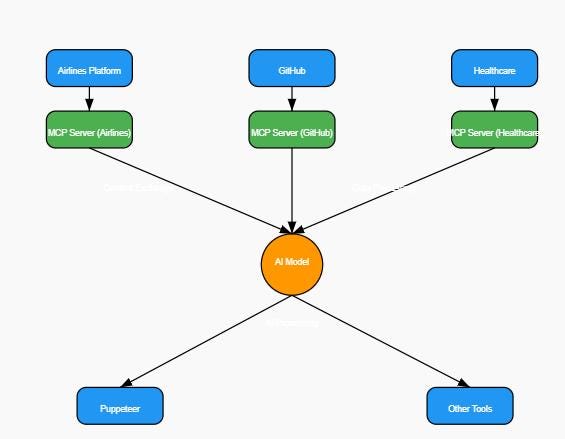
With MCP, each system exposes itself as an MCP Server.
The AI acts as an MCP Client.
Instead of learning 20 APIs, the AI speaks one protocol.
AI Assistant → MCP → Tools / Databases / AppsThis dramatically simplifies orchestration.
4. Step-by-Step Real-Time Workflow Using MCP
Step 1 — User asks a business question
“Show students at churn risk.”
AI receives the request.
Step 2 — AI discovers available tools via MCP
The AI checks:
CRM tool
Support system
Analytics database
Document repository
Instead of separate APIs, MCP exposes standardized tools.
6
Step 3 — AI gathers context
MCP fetches:
Student payment history
Support complaints
Product usage logs
Previous communication
All in one structured format.
6
Step 4 — AI reasons on live data
The model identifies:
Students with low engagement
High complaint frequency
Payment drop patterns
Step 5 — AI takes action
Using MCP tools, it:
Creates retention tasks
Sends alerts to sales team
Drafts personalized email campaigns
5. Business Impact
Companies implementing MCP can reduce:
Integration Cost
One protocol replaces many connectors.
Development Time
New tools become plug-and-play.
Operational Risk
Centralized access control.
AI Hallucinations
AI works on live business context instead of outdated memory.
6. Why Enterprises Are Paying Attention
MCP is becoming important because modern AI systems need three things simultaneously:
Memory
Tools
Real-time context
Traditional APIs solve connectivity.
MCP solves AI interoperability.
That is the difference.
As AI moves from chatbot demos to enterprise execution, MCP may become one of the most important infrastructure layers in agentic computing.
Official Resources
Final Takeaway
The biggest challenge in AI is no longer model intelligence.
It is model connectivity.
And MCP is emerging as the standard that may define how AI systems interact with the digital world—securely, consistently, and at enterprise scale.
—Mom AI Book